Manufacturing quits rose 24% on a year earlier, and workers left voluntarily more than twice as often as they were laid off. Food, chemical, paper and plastics plants drove the jump, and they are now hiring hard just to stand still.
The headline jobs number for September was thin: factories added 9,000 positions. The more telling figure arrived a few days earlier, in the federal data on people leaving. In August, more manufacturing workers quit than in any other month shown in the latest release, and the increase was concentrated in the food, chemical, paper and plastics plants that make up most of process manufacturing. For operations leaders, that turns retention from an HR metric into a production risk.
The Bureau of Labor Statistics' Job Openings and Labor Turnover data, as published by the St. Louis Fed, put manufacturing quits at 197,000 in August, up 23,000 on July and up from 159,000 in August 2025, an increase of about 24% in a year. The quits rate rose to 1.6% of employment from 1.3% a year earlier. That is still below the 2.1% rate across all private industry, so factories are not haemorrhaging staff by national standards. The direction is what matters: quits in the sector are rising while the private-sector rate is flat to lower.
Layoffs tell the other half of the story. Manufacturing Dive's analysis of the same release counted 95,000 manufacturing layoffs and discharges in August, so for every worker a plant let go, roughly two walked out on their own. Factory job openings stood at 522,000, up from 416,000 a year earlier. Employers are not shedding people. People are choosing to leave.
The September employment report, released on October 2, adds context. Factories added 9,000 jobs, down from a revised 15,000 in August, and six industries lost jobs, among them food, beverage and tobacco, paper products and chemical products. Scott Paul, president of the Alliance for American Manufacturing, was quoted by Manufacturing Dive saying that "manufacturing's slow but steady job growth since the beginning of the year has been a real bright spot." Steady net growth can hide a lot of churn underneath.
Split the BLS figures into durable and nondurable goods and the August spike has a clear home. Quits in nondurable manufacturing, which covers food, beverages, paper, chemicals, petroleum, plastics and textiles, rose from 69,000 in July to 97,000 in August, and the quits rate climbed from 1.5% to 2.0%. Quits in durable goods, from machinery to vehicles, slipped by 5,000 over the same month. Nondurable plants accounted for more than the entire monthly increase in factory quits.
Those plants are hiring to fill the gaps. BLS hires data show nondurable goods hires rising from 114,000 in July to 145,000 in August, a hires rate of 3.0%, the highest in the months shown. Yet job openings in nondurable goods fell to 142,000 from 165,000 a year earlier, while openings in durable goods rose from 252,000 to 380,000. Process plants are not expanding their workforces. They are replacing the people who left.
That pattern is expensive in ways a headcount report does not show. A food or chemical line runs on operators who know how a particular filler, reactor or extruder behaves on a bad day. Each departure takes some of that judgement with it, and each new hire spends weeks learning it again while supervisors cover the gap. The Society for Human Resource Management estimates the cost of replacing a frontline worker at $4,700, a figure cited in goHappy's research, and that excludes the scrap, slower changeovers and safety exposure that come with a less experienced crew.
The engagement data point to where the problem sits. goHappy's 2026 State of the Frontline Worker report, produced with Lighthouse Research & Advisory and drawing on almost 53,000 frontline workers across seven industries, found manufacturing had the lowest engagement baseline of any sector it tracked, at 67.1%. The good news is that manufacturing turnover among the employers it studied fell from 37.2% to 33.0%. In the report's independent benchmark of 2,000 US frontline workers, only 45.2% rated their leaders favourably on communication, 40.0% on appreciation and 32.6% on coaching.
Recognition appears to move the numbers. Workhuman's National Manufacturing Month analysis reports that 77% of recently recognised deskless workers in its 2026 Humans at Work Barometer see a career path at their employer, against 46% of those who have not been recognised. Across 34 clients and more than 67,000 offline workers, it found that employees receiving five or more awards a year, at least one with monetary value, showed four times lower turnover. Workhuman sells recognition software, so its findings deserve scrutiny, but they match the goHappy data: frontline workers stay where a supervisor notices the work and explains what is changing.
None of this requires a new plant-wide programme. It requires supervisors with the time and information to talk to their crews, which is exactly what thin staffing and constant backfilling erode.
Treat the rise in quits as an operational signal and manage it with the same discipline as downtime or scrap.
The August quits figure is a single month of preliminary data and may be revised. But the gap between a flat national quits rate and a rising one in process manufacturing is worth taking seriously. Plants that are hiring hard just to stand still are paying for turnover twice, once in recruitment and again on the line. The ones that hold on to the operators they already have will find the labour market far less tight.

Report
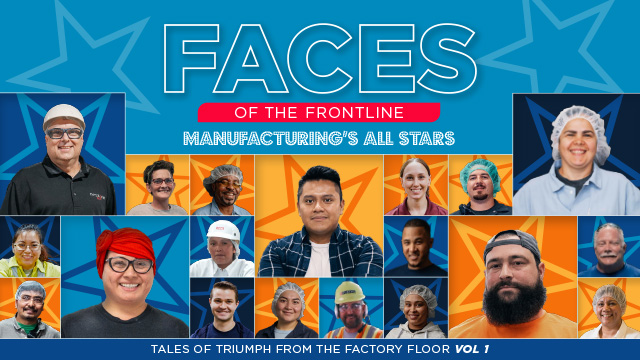
With quits in process plants up by 28,000 in a single month, retention programmes built around an average worker are falling short. This report profiles who today's frontline workers are and what keeps them at one plant rather than the one down the road.
Download

Guide
Only 45.2% of frontline workers rate their leaders well on communication, and that gap widens when managers oversee crews they are not standing beside. This guide covers how operations teams keep on-site crews and remote managers working from the same real-time picture.
Download

Guide
When a third of a frontline workforce turns over in a year, every new system has to be learnable by people who were not there when it launched. This guide covers how to scope, prepare teams for and sequence a digital rollout so new tools get adopted rather than worked around.
Download