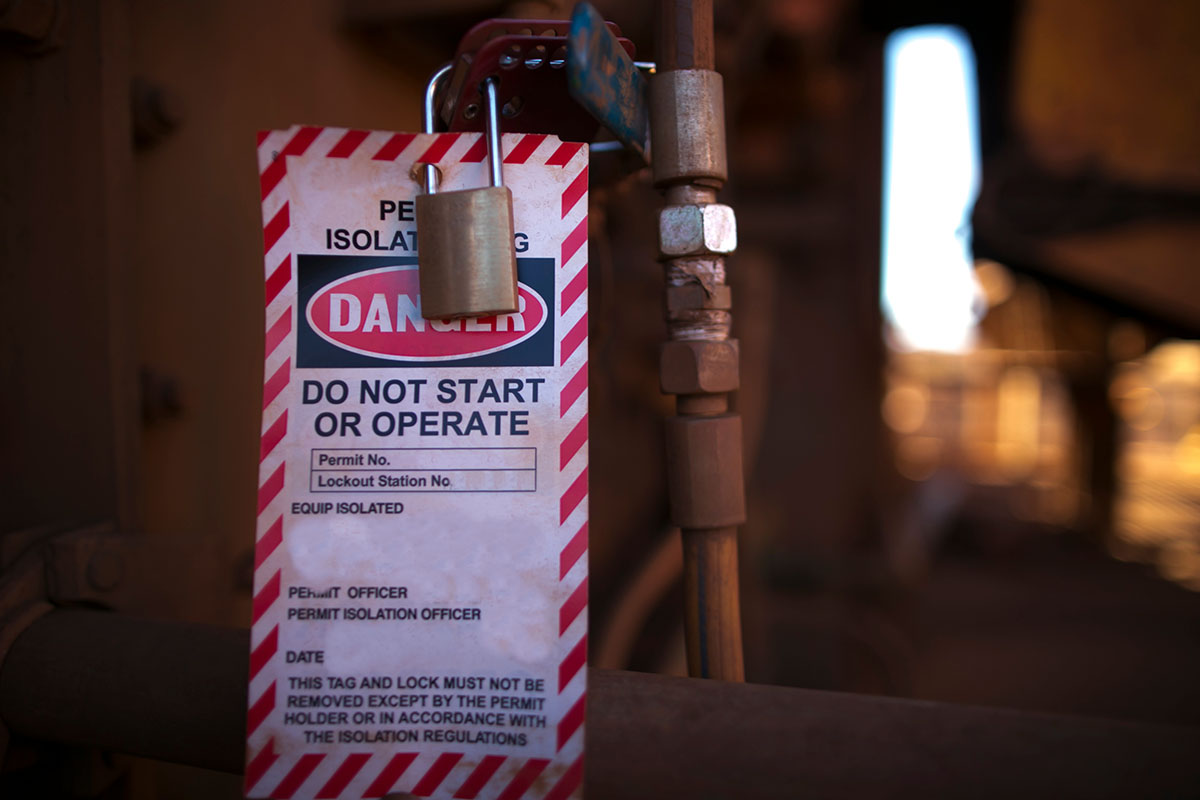
Lockout/tagout climbed to third on OSHA's preliminary list of most-cited standards for fiscal 2026. This week's clean-downs, sanitation shifts and restarts are exactly the work the rule covers, and much of it falls to temporary and contract crews who are new to the site's procedures.
For many plants, Thursday's holiday is the one point in the fourth quarter when the lines stop long enough for a deep clean, a sanitation shift or a batch of deferred maintenance, before restarting on a compressed timetable. Food plants arrive at it running hard: the American Farm Bureau Federation's November 5 market analysis puts federally inspected turkey meat production at 5.13 billion pounds this year, up about 6%. Every clean-down and restart in that window is servicing and maintenance in the sense OSHA's lockout/tagout rule uses, and the latest enforcement record says it is a rule plants keep breaking.
As Insurance Journal reported on November 18, OSHA has cited Banneton Bakery LLC, a pastry manufacturer in Swedesboro, New Jersey, after an April 28 incident in which a worker supplied by Idalia's Staffing Agency got an arm stuck while cleaning a moving conveyor and needed medical treatment. It was not the first time. In January, an employee cleaning the same conveyor belt broke an arm, and the machinery was not locked out during the cleaning.
The bakery faces $340,479 in proposed penalties. Its two willful violations are for failing to develop and use lockout/tagout procedures and for failing to provide training adequate for employees to understand the purpose and function of energy control. Three serious items cover ladder side rails, an unprotected ladderway floor hole and the improper use of group lockout devices. Idalia's Staffing Agency, based in Vineland, faces $10,641 for one serious violation: not ensuring temporary employees received lockout/tagout training. Both employers have 15 business days to comply, request an informal conference or contest the findings.
The pattern is familiar in the same town. In November 2025, OSHA proposed $1,125,484 in penalties against Taylor Farms New Jersey after a worker was fatally injured while cleaning and sanitising a machine at its Swedesboro fresh-cut vegetable plant. The agency found 16 willful and repeated violations tied to missing lockout/tagout procedures and training, and cited the onsite staffing agency for three serious violations of its own. Two cases, two staffing agencies, one task: cleaning equipment that was still able to move.
National Safety Council figures on OSHA's preliminary fiscal 2026 data, reported by Business Insurance in September, show lockout/tagout moving to third from fourth with 1,863 violations. That was a 14.4% fall, but a smaller one than the 24.8% drop in combined violations across the top 10. OSHA's own top 10 page, covering October 1, 2025 to August 31, 2026, ranks control of hazardous energy third behind only fall protection and hazard communication, with machine guarding tenth. Fewer citations overall did not make the energy control failures go away.
A holiday shutdown stacks the conditions the standard, 29 CFR 1910.147, works hardest to control. It applies to servicing and maintenance where the unexpected energisation or start-up of equipment could injure someone, and sanitation of a conveyor or mixer is squarely that work. When outside crews arrive, the rule requires the on-site and outside employers to inform each other of their respective lockout procedures. When a lockout runs across a shift or personnel change, it requires specific procedures for the orderly transfer of lockout protection between off-going and oncoming employees, which a four-day weekend with skeleton staffing can easily break.
Restart carries its own requirements. Before locks come off, the work area must be checked to ensure all employees have been safely positioned or removed, and affected employees must be notified that the devices have been removed. On a Monday morning push to recover volume, with sanitation contractors finishing as production crews arrive, that check is the step most likely to be compressed. Banneton's citation for misusing group lockout devices is a reminder that multi-person jobs, the norm during a clean-down, need their own discipline.
The standard is explicit on one point that modern plants often blur: push buttons, selector switches and other control circuit type devices are not energy isolating devices. A conveyor stopped from an HMI, held by a PLC permissive or idled by an e-stop has not been locked out. On connected lines, where equipment can be commanded from a control room or a remote session, isolation at the energy source is the only protection that does not depend on someone else's screen. Sanitation adds stored energy to the list as well: tensioned belts, pneumatic lines and gravity loads that stay live after the motor stops.
The holiday shutdown is not the problem. It is the best chance most plants get all year to do this work properly, with the line down and time to verify. The risk is treating restart as a production milestone rather than the final step of a lockout procedure.


Guide
Banneton and its staffing agency were both cited over one untrained temporary worker, and this guide sets out how to qualify, oversee and track the outside firms whose crews carry out your holiday sanitation and maintenance.
Download

Guide
A stop issued from a screen is not isolation under OSHA's rule, and this guide covers the network design and operational protocols that govern who can command connected equipment while a clean-down crew is inside the guards.
Download

Report
OSHA requires lockout protection to pass in an orderly way between off-going and oncoming crews, and this report shows how high-performing plants move knowledge between shifts so a four-day Thanksgiving weekend does not break the chain.
Download